Our Day
An app designed to bridge the gap and strengthen the emotional bond between partners in long-distance relationships.
Target Group
People in long-distance relationships
Goal
Strengthen the bond between them and their partner
Team
4 designers
Duration
2 months
The Problem
Disconnected
People in long-distance relationships often feel disconnected from their partners.
Uninvolved
People in long-distance relationships often feel uninvolved in their partners’ daily life.
Difficulty with challenging conversations
People in long-distance relationships find it difficult to bring up challenging conversations, which can lead to an emotional gap.
Our Solution
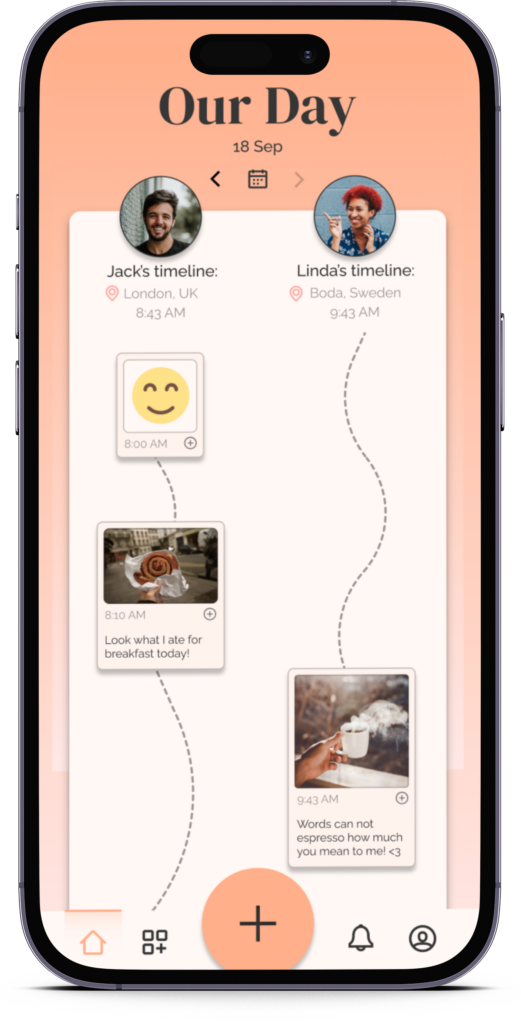
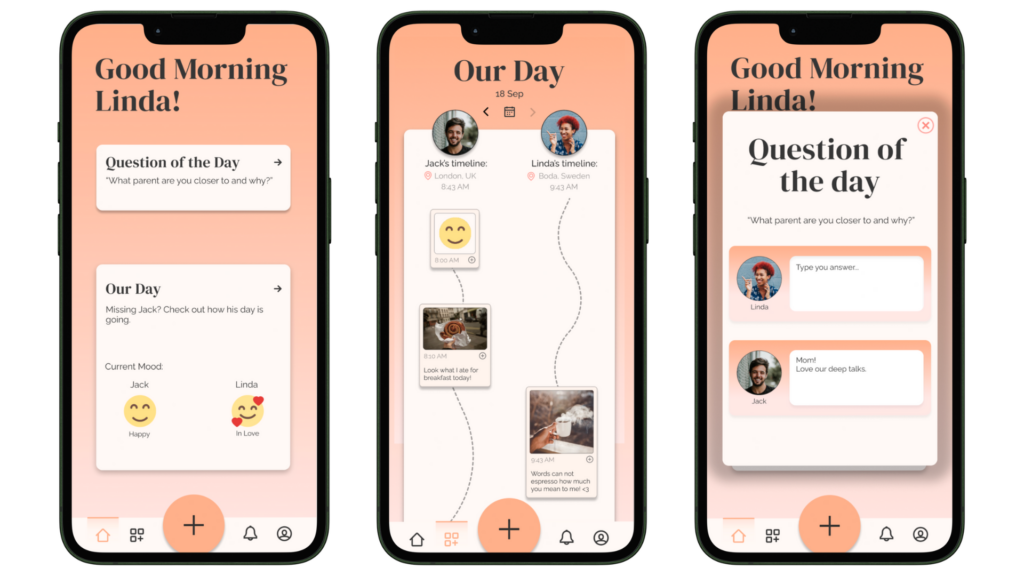
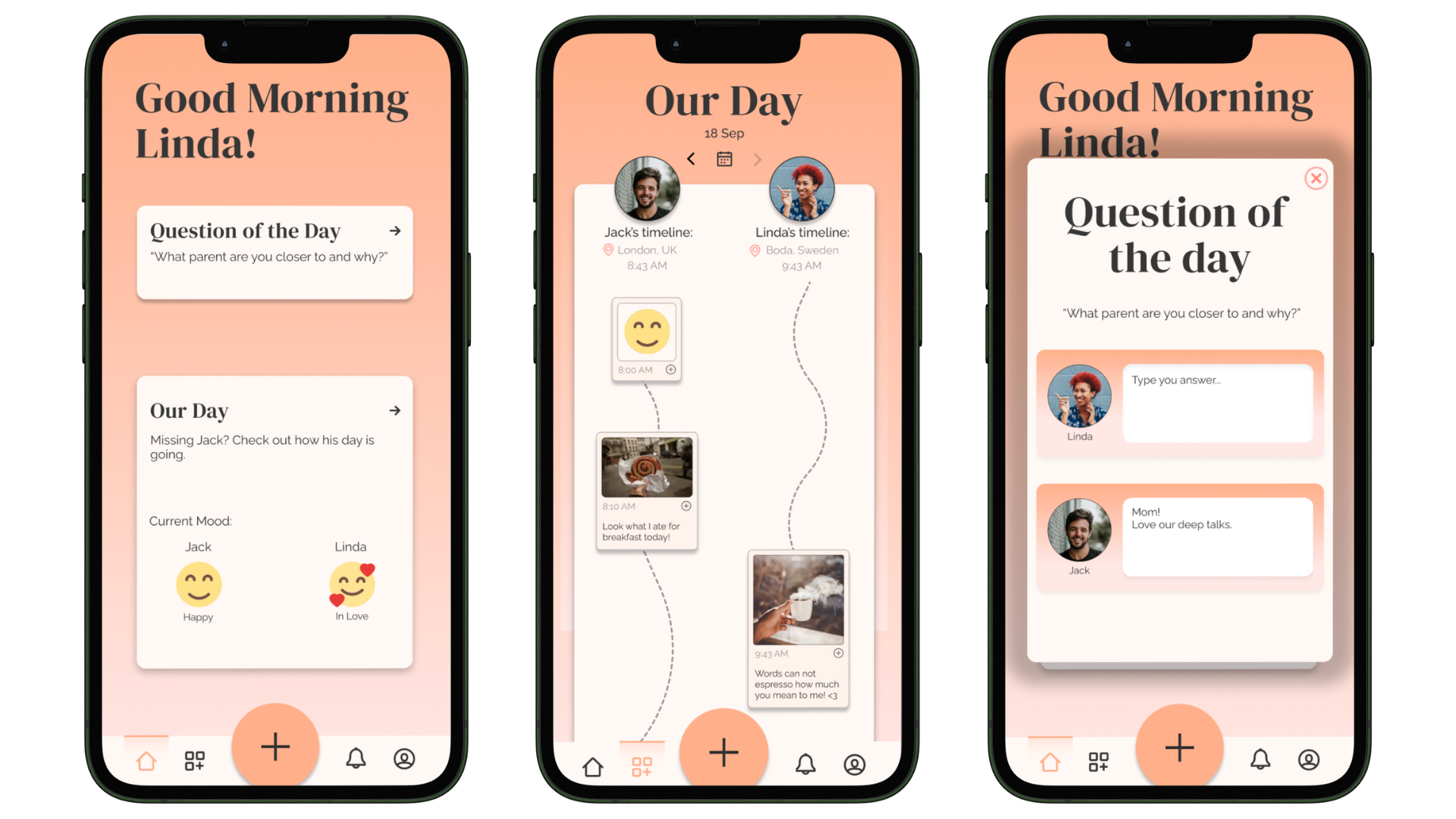
A couples app where both partners connect their accounts to create a shared timeline of their days. They can share pictures, feelings, videos, and messages. The app also displays both partners’ current moods on the homepage, allowing them to see how the other is feeling without asking. Additionally, there’s a “Question of the Day” feature, where both partners answer a different question daily to help bring them closer.
Design Process
1. Discover
User Interviews
2. Define
User Need Statements
3. Develop
Sketching
Paper Prototype + Usability Testing
Digital Prototype + Usability Testing
4. Deliver
Interactive Digital Prototype
User Interviews
The interviews were 30 minutes, semi-structured, and included 6 people and 1 couple. The questions fell under the following categories:
General relationship information
How did you meet?
Has your relationship always been long-distance?
How often do you meet online? In person?
…
The relationship in practice
What activities do you do at a distance?
How much time do you spend communicating? What do you use?
What types of dates do you have?
…
The good, the bad and the ugly
What are the advantages of long-distance?
What’s the most frustrating part of long-distance?
How does your partner make it easier?
…
User Need Statements
Based on the interviews we came up with 14 User Need Statements and noted how common these were based on how often we encountered them in the interviews.
- A person in a long-distance relationship needs a way to share their own everyday experiences with their partner in order to feel like their partner is a part of their lives/intimacy. (3 times)
- A person in a long-distance relationship needs to have common friends with their partner in order to feel like a part of each other’s lives. (2 times)
- A person in a long-distance relationship needs to do activities with his/her partner, although remotely, in order to accomplish intimacy. (6 times)
- A person in a long-distance relationship needs a quick and simple way to communicate (messages, pictures, videocall…) with his/her partner regularly in order to accomplish feeling involved in his/her life. (5 times)
- A person in a long-distance relationship needs to schedule/make time for each other in order to stay in touch and keep the relationship going. (2 times)
- A person in a long-distance relationship needs to visit his/her partner every now and then in order to accomplish feeling that you are a part of his/her life. (3 times)
- A person in a long-distance relationship needs alternative ways to help his/her partner during difficult times when they are apart in order to be there for him/her. (2 times)
- A person in a long-distance relationship needs ways to do small special things once in a while in order to show his/her partner appreciation. (2 times)
- A person in a relatively new long-distance relationship needs to find others in similar situations in order to get support. (2st)
- A person in a long-distance relationship needs to know what the other person expects from the relationship and vice versa in order to accomplish stability and no misunderstandings. (2 times)
- A person in a long-distance relationship needs a way to see, not only talk to, his/her partner between visits in order to accomplish feeling close to him/her. (7 times)
- A person in a new long-distance relationship needs to be able to sync his/her calendar with the partner and vice versa in order to plan when they can meet in real life or remotely. (1 times)
- A person in a long-distance relationship needs to have a joint plan for the future with his/her partner in order to feel calm and have motivation during tougher periods. (1 times)
- A person in a long-distance relationship needs a way to flow more naturally into more serious and personal topics/feelings to feel connected to their partner. (3 times)
Possible Ideas
1. A website where you can get inspiration for joint activities even when you’re apart. Examples of categories are food, exercise, movies to watch, and games.
2. An app where two people can sync their calendars. The app has an optional feature to show an overlay of your partner’s schedule that shows visually what times that are available to both people (optional since some users value their privacy and independence).
3. An app with one serious question per day that is asked to both partners. The answers become visible at the end of the day.
4. A website with a community where you can answer or ask questions (option to be anonymous) and get expert advice. Articles by experts are posted weekly.
5. An app where partners can see an overview of each others’ day, through pictures, local weather, and time. The app is primarily meant to have a low threshold and be simple to use.
Sketching
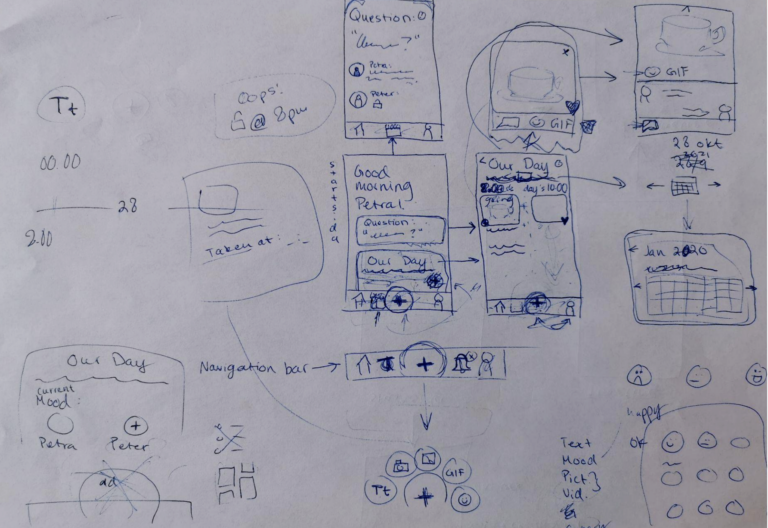
We decided to combine ideas 3 and 5 into an app and sketched different designs that would incorporate the two ideas.
Paper Prototype
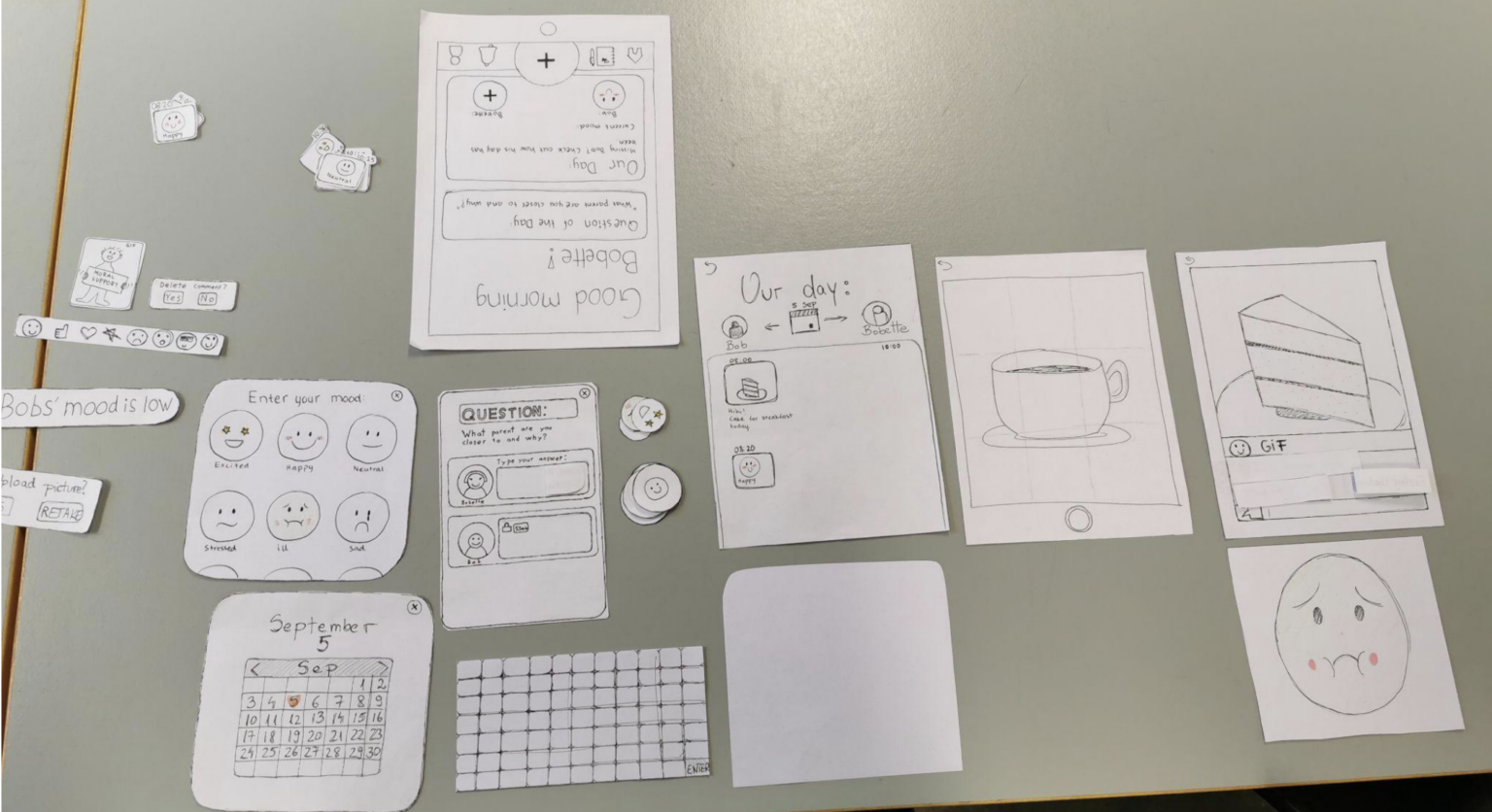
We created a paper prototype inspired by our sketches on which we conducted two rounds of usability testing, one with our classmates and one with our interview participants. We used the scenarios created before and the Wizard of Oz method to simulate interaction. We then compiled a usability specification and prioritised which of the identified usability issues to address for a design iteration.
Key Feedback from Users
Button symbols for some of the buttons were confusing to the users and were changed to be more intuitive.
Digital Prototype
We created a digital interactive prototype in Figma on which we conducted two rounds of usability testing.
Key Feedback from Users
Users found it intuitive to click on the “mood” buttons directly from the front page which was not possible before. Fixed in final design by implementing functionality. Button affordance was lacking and users were confused about which buttons were clickable and which were not. Drop shadows were added to the clickable buttons
Design Solution
Main Page
Users can view and access the question of the day. They can also see both moods and change their own by clicking on the mood emojis.
Timeline Page
A shared timeline for both partners, where they can upload pictures, videos, texts, and more, displayed side by side. This allows them to see what the other was doing at the same time, helping them feel more involved in each other’s day-to-day lives.
Question of the day page
One thought-provoking question each day that both partners can answer in order to feel more connected to each other.
Challenges and Learnings
The importance of leaving biases behind
When we began our user research, we held a common bias: that long-distance relationships are inherently difficult, and everyone in one is eager to move closer as soon as possible. Fortunately, our interview questions also addressed the positives of long-distance relationships, which led us to realise just how wrong we were. Many of our participants highlighted more benefits than drawbacks to being in a long-distance relationship. While they did express a desire for their relationships to eventually become geographically closer, they also enjoyed the freedom that distance provided.
One couple we interviewed, married for 10 years with children, had spent most of their relationship living apart due to their career priorities. They seemed genuinely happy and content with their decision. This experience opened my eyes to the importance of asking questions objectively, allowing us to uncover the full story rather than just information that aligns with our preconceived opinions.